
Germany and Europe are headed for a rough LNG-Winter
All is well in the land of German and EU gas imports, or so it seems when listening to official pronouncements. As early as July 7, the EU Gas Coordination Group openly declared that ‘…there is currently no immediate concern for the security of gas supply in the EU for the next winter season.’This came after statements by Germany’s Economics Minster Katharina Reiche and the Bundesnetzagentur, that there was no risk to German gas supplies resulting from the war against Iran. Energy security was ensured through the winter.
Now, with the start of the heating period only 6 weeks away, Germany’s gas storage just about scraped above the 50% line. While observers argue if this means that storage is half empty or half full, one fact cannot be denied: It is significantly lower than the five-year average for the same time of the year. To put in specific numbers: The current fill rate for Germany stands at 50.14%, which is 27.14 percentage points below the average for the same date for the years 2021 to 2025 of 77.23%. Notably, this includes the 2021/2022 gas crisis, when the lowest fill rate was 50.15% in 2021. It is almost too on the nose that even during the energy crisis in the run-up to Russia’s invasion of Ukraine, Germany’s storage stood 0.01 percentage point above its current value.
This, however, does not cause too much official concern in Germany’s energy policy landscape. Both Katharina Reiche and Klaus Müller, head of the Bundesnetzagentur, confidently called upon gas traders to ‘live up to their obligations towards their customers’. Germany’s Emergency Plan For Gas remains at the early warning level, which is two levels below a state that would warrant government action. While Ms. Reiche plans to introduce a government-run emergency stock, this is not to come into being before Winter 2027. It is also to be funded by an extra payment by Germany’s gas consumers, adding a further burden on the country’s already overstretched energy budgets. Meanwhile, the EU Commission stated again that is ‘not concerned about gas supply or storage filling’.

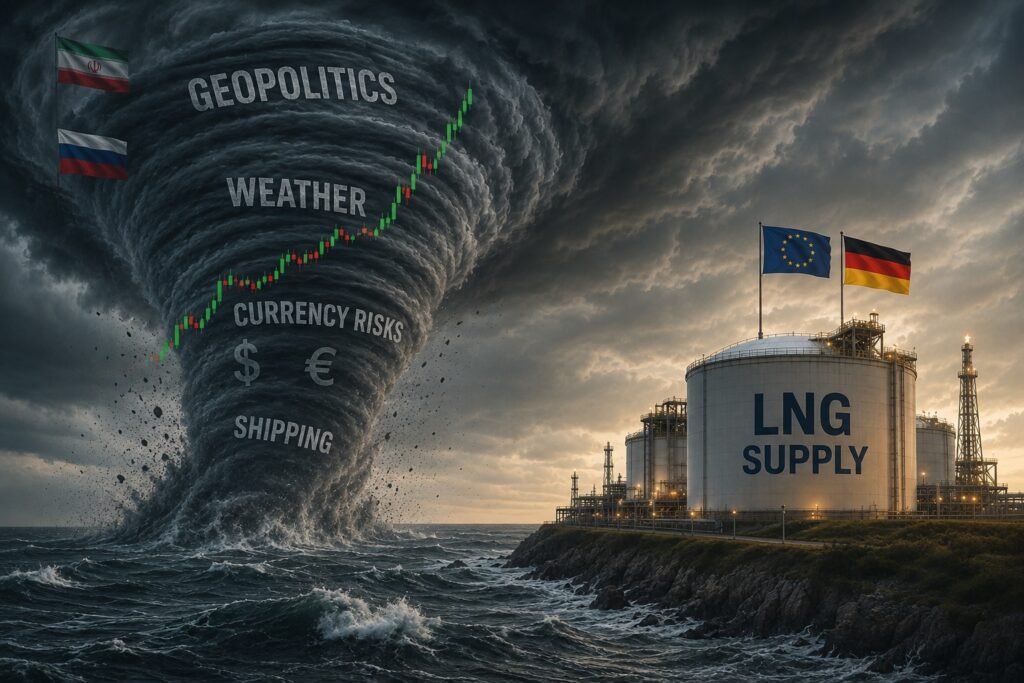
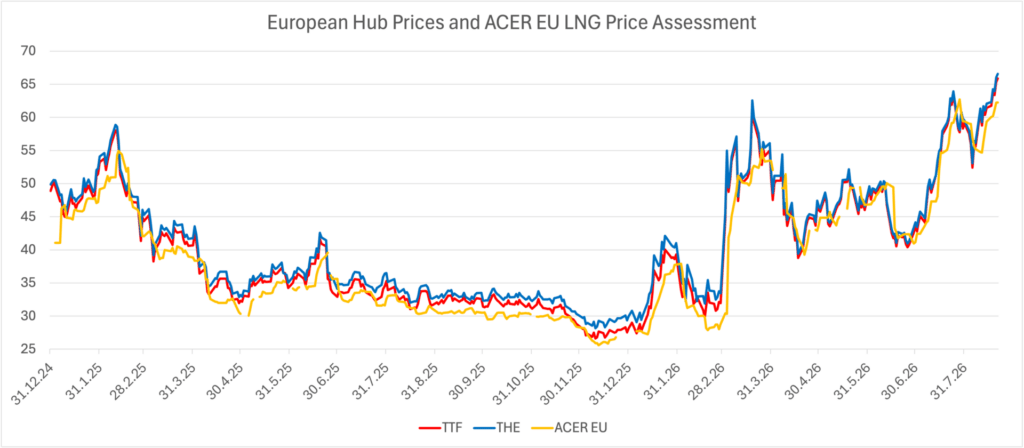
Admittedly, both Reiche and Müller state that there might be a price reaction to the current crisis in Hormuz. In fact, that reaction is quite pronounced, with TTF-Futures ending the week above € 65 per MWh. This is still below the fantastical levels seen at the high point of the 2021/22 energy crisis. But it is significantly higher than any settlement price since January 2023. This alone would be cause for concern, but a number of further indicators point to a perfect winter storm for LNG markets. Without a more pro-active approach, official Germany risks sleepwalking into that storm, caught in a hands-off strategy for energy commodity supply that was a better fit for the rules-based globalization of 2015 than it is for the politicized, crisis-ridden world of 2026.
Iran: Submission, Escalation or Muddling Through?
The first factor contributing to this storm is of course the Iran war itself. With the US and Iran dug into their respective hardline positions, the reopening of the Strait of Hormuz seems unlikely in the near future. In fact, with their recent threat of economic sanctions against all countries that economically support Iran (mainly China) the US government has added an additional layer of destabilization to the global economy. Meanwhile, Iran has no incentive to give in to the US or come to a conciliation on its position on the Strait.
This leaves two extreme options: The first option is for the US to accept defeat and Iran implementing its vision of future traffic through the Strait. This would mean a fee of between 3 % and 7% on any cargo crossing the Strait. It is unclear, how this fee would be calculated, but the cost effects on a typical LNG cargo of app. 174,000 cubic meters or 6,264 MMBtu would fall between 4.1 million and 9.5 million Dollar. More than that, Iranian control over the Strait of Hormuz would also cut off several US military bases from access by sea. This is unlikely to be acceptable to the US, so the second radical option is all-out warfare, possibly including a ground invasion of Iran. Some analysts see this as the most likely outcome. However, both the MAGA movement and the broader US public are skeptical towards outright military escalation, especially if that would involve ground forces. In addition, the current administration has shown significant hesitancy to openly confront an opponent that has the capacity and will to resist its attempts at coercion. In these cases, it mostly leans towards tactical de-escalation, while keeping the underlying objective intact.
Therefore, the most likely outcome over the next months is a continuation of the status-quo, with threats of escalation intermittently ebbing up and down. The results for LNG markets would be both higher prices, due to the delayed access to volumes from Qatar, and greater volatility, due to the frequent policy changes that have become the hallmark of US foreign policy. Neither of these is good news for LNG importers, who must manage greater uncertainty at a higher price level in already constrained markets.
Weather: Keeping Prices Up
This is not helped at all by weather, the second factor that feeds into the perfect storm. All signs currently point to a Super El-Nino, which means two things: First, a hotter summer that drives electricity consumption for cooling higher, while reducing the water needed for nuclear or hydro power generation. The result is the bullish development of gas demand the markets saw and still see in this summer. And with temperatures of around 30°C persisting in Beijing, Shanghai, Seoul and Tokio, while large parts of South Asia are set for higher-than-normal temperatures into October, there is little bearish influence on the current gas situation. This implies continuously increased competition for available spot market volumes of LNG, which puts even more pressure on prices. Already, Pakistan, Bangladesh and India have ramped up spot market imports, with imports also up in China (although down in Japan). And there are few signs that the demand pressure is going to let up. All this implies that EU importers will face tough competition over short-term available cargoes at a time when filling the gas storage facilities is imperative.
Shipping Lanes: The Everywhere Blockade
And bringing these cargoes to port might become more difficult in the near future. Already, three of the five most important maritime bottlenecks are impacted by geopolitical uncertainty: The Strait of Hormuz is effectively closed, while the Bab-al-Mandab and hence the Suez Canal are under threat from Houthi attacks. Now, the drought conditions in Panama threaten water supplies to the Panama Canal. This already impacts shipping. Earlier in August, reports emerged that an empty LNG tanker paid $ 4.6 million in an auction to ensure preferential transit through the water way. Later in the month, Canal Authorities capped transit at 34 ships daily, starting early September. Currently, transit through the Panama Canal is the main economic route for US LNG exports to Asian markets. Should that option vanish or be further restricted, more deliveries would have to reroute around the Cape of Good Hope. If that happens, Asian customers will have to pay higher prices for the rerouted cargoes to compensate for the shorter transit routes, and hence lower transportation costs, to Europe. This, in turn, would further intensify existing bullish price pressures, since European importers would have to ramp up their own offers to prevent losing cargoes to Asia. Overall, the fact that 4 of the 5 main sea routes for LNG are fully or partly blocked is a clear price and a potential volume risk for LNG markets.
Dollar Volatility: The Less Discussed Risk
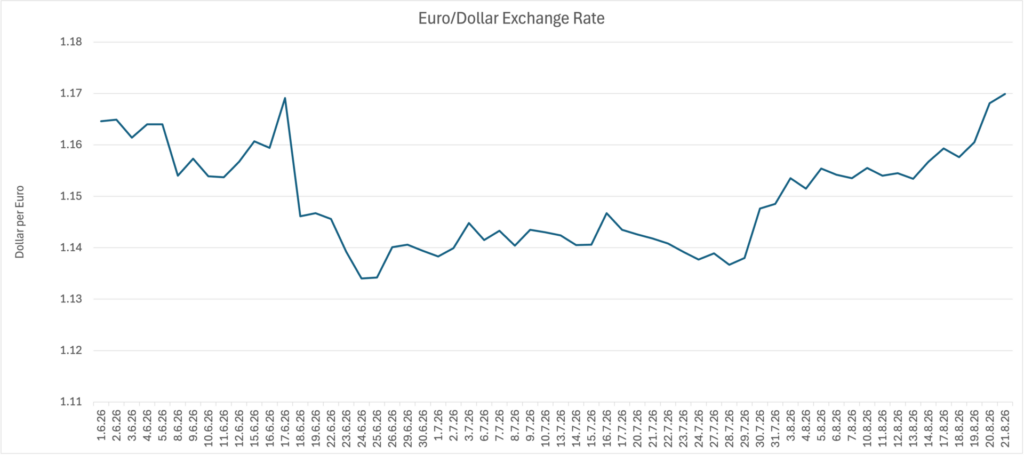
A risk factor that is less widely discussed is the current US financial crisis. Since LNG is mostly traded in US Dollars, fluctuations in the exchange rate influence real prices. With US debt now reaching $ 40 trillion and the country spending more on its debt than on its military, this weakened financial position adds further uncertainty to LNG markets over the next months. On August 19, when Treasury Secretary Scott Bessent announced a large-scale buyback of US bonds, the Dollar jumped overnight from € 1.1605 to € 1.1681, i.e. by around 0.8 Cents or 0.7%. This might not seem much but is the second highest exchange rate jump for the Dollar this year. Treasury announcements of further interventions have increased investor fears of structural Dollar depreciation. One big investor is already selling off Dollar holdings to protect against a possible crisis. An extended Dollar crisis might support LNG importers via a more beneficial exchange rate and hence lower real prices. But the currency volatility emerging from an ongoing cycle of interventions and market fears in the financial sector introduces another level of risk to global LNG trade. In addition, a structural Dollar weakness could encourage attempts by other countries, especially China, to establish their own currencies as global alternatives. While not immediately relevant to LNG prices, this would increase market complexity, making risk management even more complex.
Altogether, these factors add up to a perfect storm for global LNG markets, including EU imports. It is hard to find an aspect of the business that is not facing increased risk at a time when empty storage facility increases buying pressure. Meanwhile, the German government calls on German traders to fulfil their ‘obligation towards their customers’, ignoring the fact that current spreads provide at best minimal financial incentive to store gas. (The M2-M1 spread is slightly positive while the front-month-to-winter spread is in relevant backwardation). Without strong government intervention, it seems unlikely that Germany’s storage targets will be reached. But government intervention, it seems, will not be easily forthcoming. Under these circumstances, LNG importers should ramp up their risk management systems. FX and shipping futures might offer some stability against increasing volatility. Potentially, surprise events could diffuse some of the tension. A quick US-Iran peace deal might resolve some of the pressure emerging from the crisis of Hormuz and lower prices. And a strong El Nino might even reduce European gas demand. But neither will immediately bring back all Qatari supply, nor will it resolve weather or currency related volatility. The likelihood is for a Winter of high prices, increased volatility and heightened sensitivity to crisis events. LNG markets are headed for a perfect storm and no market participant should be asleep at the wheel.