
While the German Government retains a hands-off approach, warning signs are flashing for its gas supply.
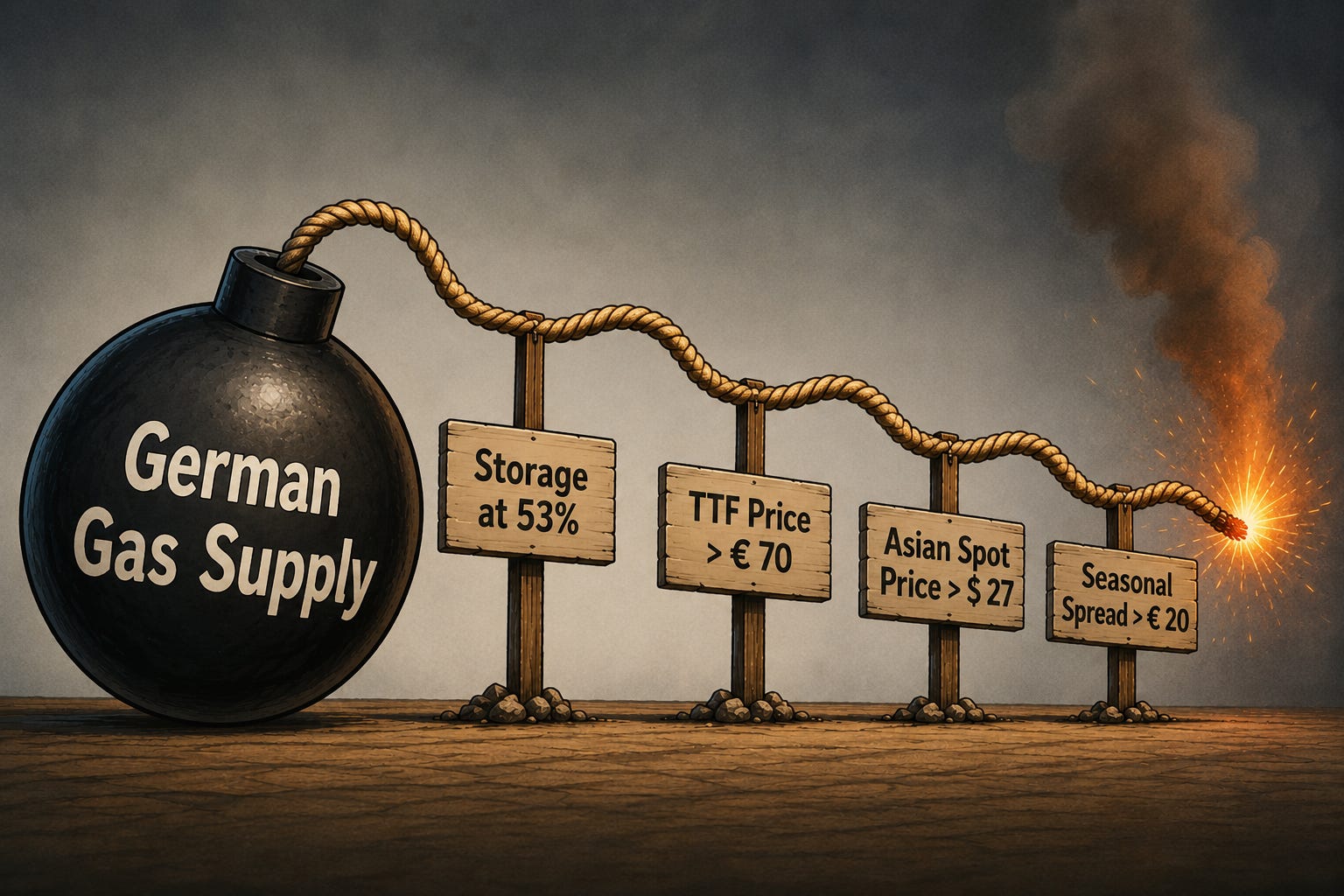
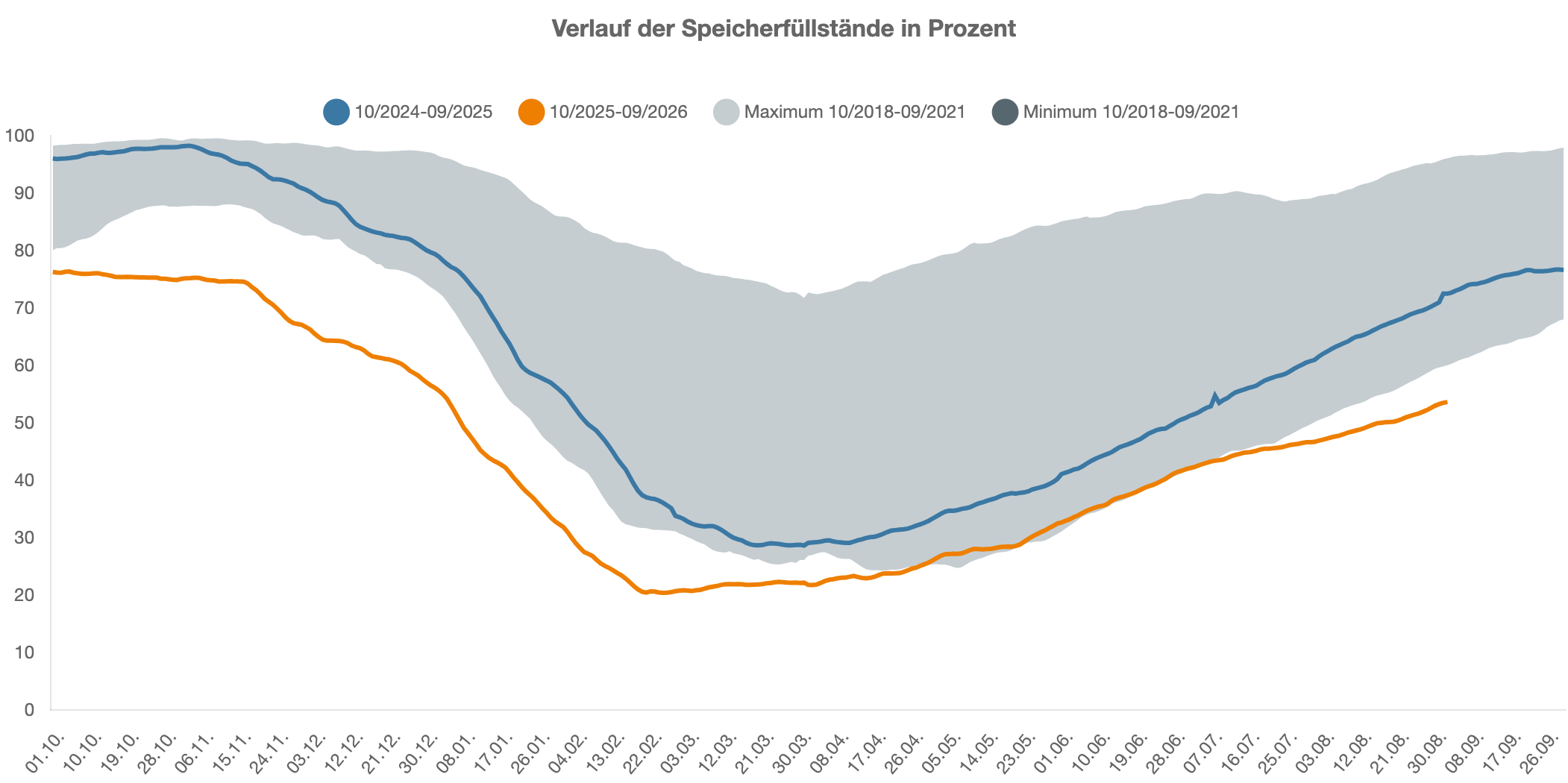
With four weeks to go until the start of the heating period, gas storage is filled to less than two thirds in the EU average (65.06%) and a bit more than half in Germany (53%). For both cases, the legally prescribed gas storage objectives are at this point likely unattainable. For Germany, forecasts for November 1 vary between 57% and 71%. This is significantly below the 76% that formed the base case for the last INES storage projection for July. Back then, the German gas storage operators saw a real risk of empty storage facilities in early 2027 if the winter would prove to be cold. An announced update on September 8 will provide fresh insights on their risk assessment in a world where 76% seems firmly out of reach. (Even an inherently optimistic simple Winter-Holt projection sees German storage levels at below 63% on October 1. This would not meet the INES trajectory for reaching 76% by November.) For the EU, most projections land at around 70%, with extreme values reaching up to 84%. Rystad Energy’s very optimistic base case would see storage at 76%, still significantly below the 89.8% that is the five-year average. On a more positive note, temperatures are forecast to remain warmer than average into October, making stronger fill-in rates possible. Still, as stated above, this is likely insufficient for Germany to reach its storage targets.
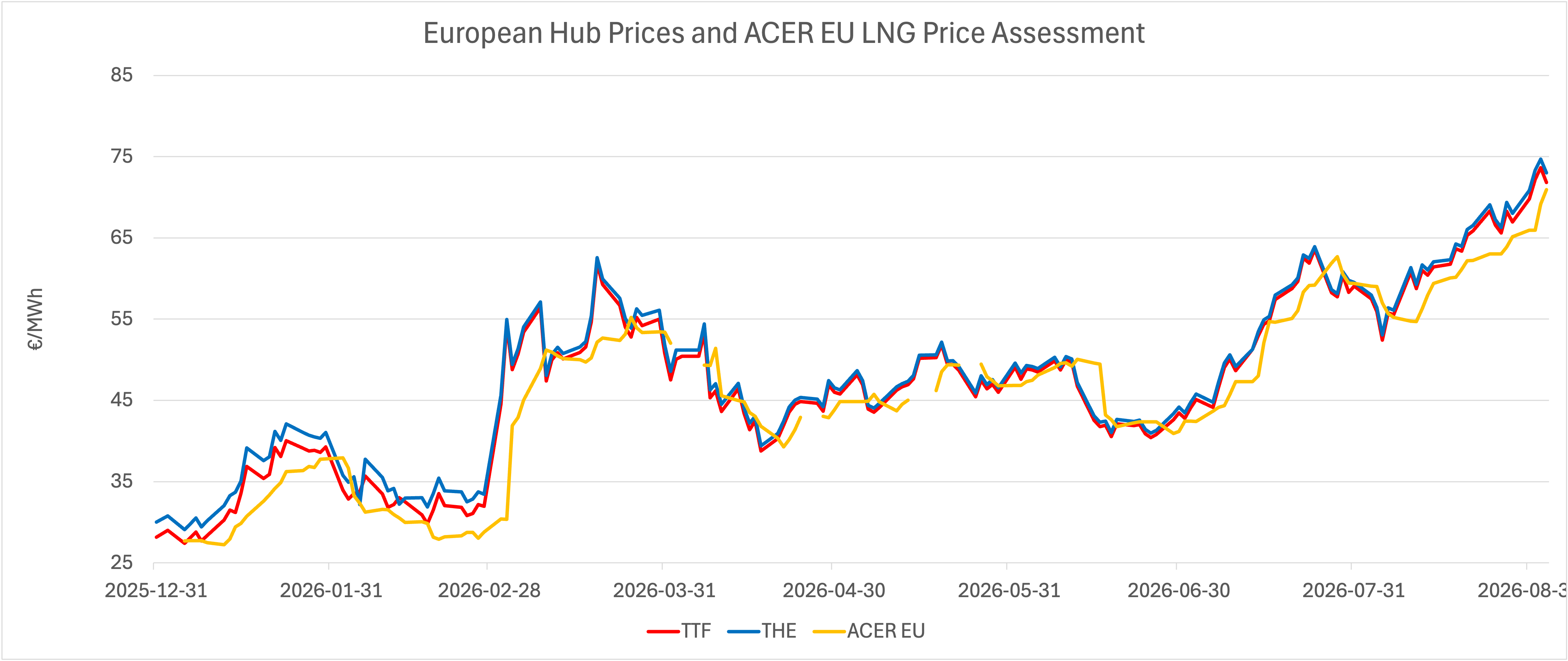
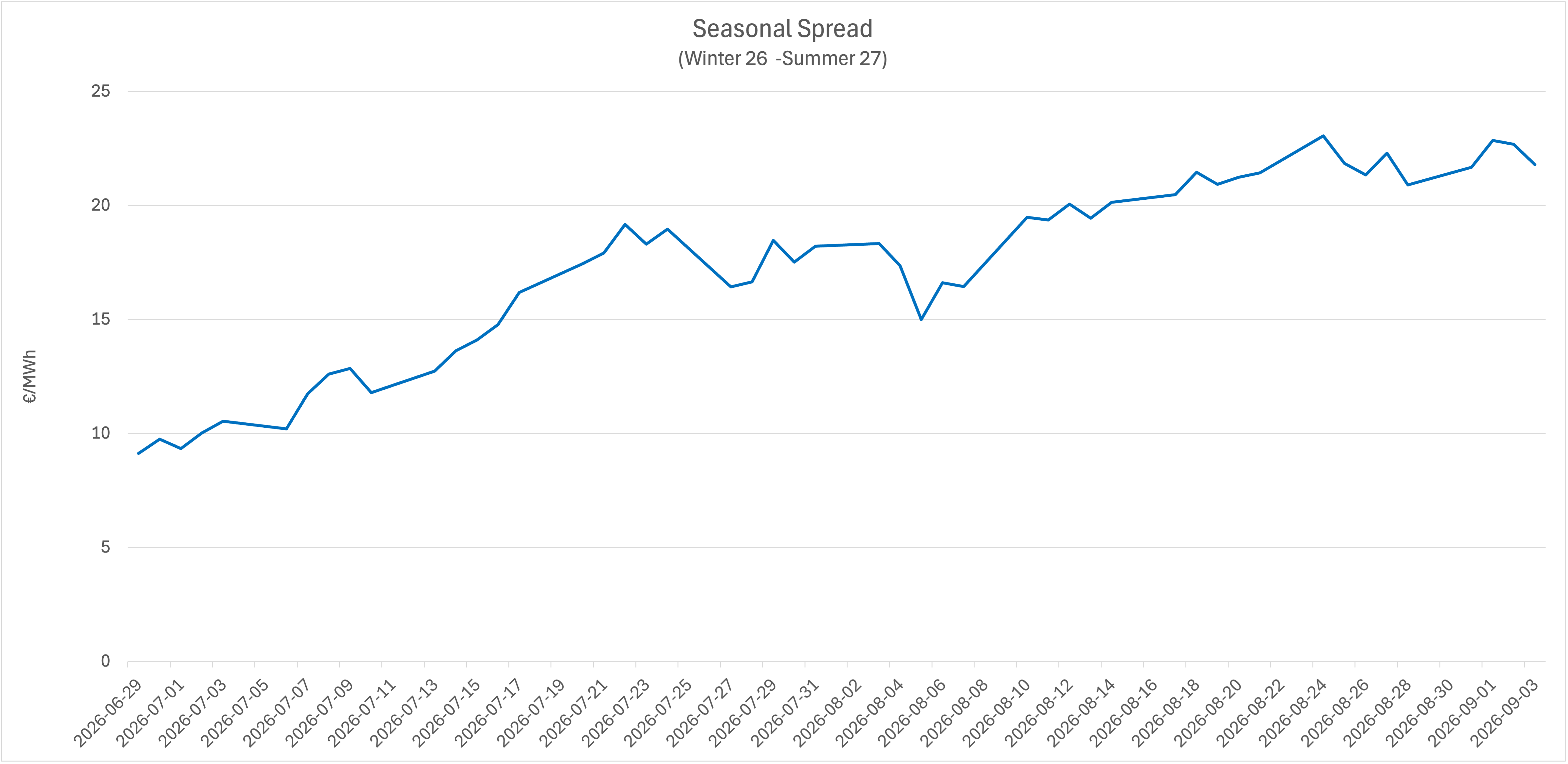
The tense storage situation combined with the revived attacks at the Strait of Hormuz has flamed a massive spike in EU wholesale gas prices. On September 1, TTF prices breached the threshold of € 72/MWh and remained continuously above €73 throughout trading on September 2. Meanwhile, the M2-M1 spread at the TTF has turned to backwardation, reaching € -1.64 per MWh on Monday before returning to a more moderate € -0.33. by Wednesday. While less relevant during the heating period, it still disincentivizes putting gas in storage during a presumably warmer than usual October. The seasonal spread remains wildly untypical at € 22.855 of Winter’26 over Summer ’27, underlining the urgent need for Germany and the EU to import LNG during a challenging winter.
One key driver behind the gas price rally is demand pressure from Asia after the outage of Qatar LNG supplies. That pressure shows no sign of letting up, with companies from Pakistan, Bangladesh and Vietnam publishing tenders for LNG spot cargoes. In addition, Bangladesh is also looking to expand its overall supplier list, diversifying its pool of possible supply sources. This drives spot prices higher, increasing upward pressure on JKM futures and hence on TTF. In late August, reported spot prices tended to land around $ 0.20 above JKM Front-Month futures. Futures subsequently caught up to meet the price level of the spot market. This dynamic should concern EU importers, given that the last reported Asian spot prices stood at $ 27 per MMBtu. With an exchange rate of 1.159 Euro per Dollar, this amounts to a price of 79.48 €/MWh.
Another data point might offer some reprieve: Japan’s Ministry of Finance has lowered the reported price for the Japanese Crude Cocktail for the first time since April. As a hypothetical oil type, the JCC is meant to reflect overall import prices for Japan’s crude portfolio. It is a significant benchmark price for oil-indexed LNG contracts in Asia and Asia-Pacific, where over 60% of imports are priced in reference to oil. The price now stands at 114.36 $/barrel, after ranging above 117 $/bl through August.
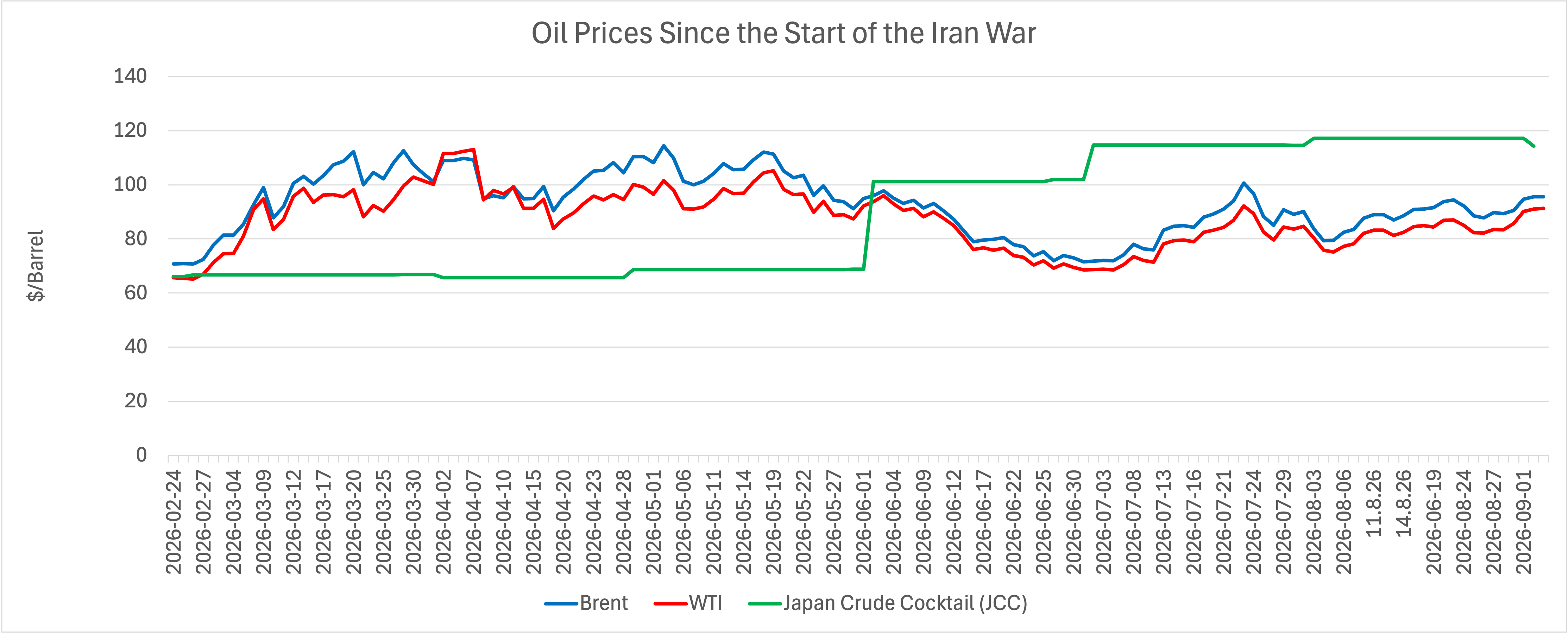
A cynic might find some more good news for EU importers. High Asian spot quotes have already priced weaker Asian importers out of the market (not for long, though). Reportedly, Pakistan rather accepted a risk of more frequent blackouts than pay the 27 $/MMBtu it was offered by BP. Meanwhile, a weaker Dollar reduces import costs on a market that is still largely Dollar-denominated. But neither should reassure EU importers too much. In the power sector, Asian importers are still more likely to replace their missing LNG supplies with coal than with renewables in the short run, counteracting attempts to mitigate climate change. Lack of natural gas is also likely to feed into a lack of fertilizers for food production, intensifying the impact of weather-related harvest shortfalls. A weaker Dollar, on the other hand, does not pose a direct risk to EU energy imports. But the US federal budget is already under immense pressure, with the administration’s panicked reactions to growing bond yields doing nothing to reduce the cost of borrowing or the government’s $ 40 trillion debt burden. Sustained financial difficulties are a likely source of volatility.
In a world where Germany inherently depends on LNG imports from the US, recent events have shown yet again the dangers of such dependence. The Canada-US trade row has no direct bearing on commodity markets – cross-border energy trade continues to be tariff-exempt. But it illustrates the stances the US administration takes in its relations with partners it perceives to be dependent. As the New York Times reported, at stake were not only bilateral trade issues but also questions at the heart of Canadian sovereignty and territorial integrity. Among other things, the US demanded that Canada implemented all US tariffs, without getting a say in their development, and that it would roll back its protection for the French language. The latter demand would have almost certainly triggered a conflict with the province of Quebec, which has threatened to secede from Canada in the past. While Germany does not directly fall under the ‘Trump Corollary’, the pressure exerted on Canada should be a reminder to treat the US concept of ‘energy dominance’ as a serious security risk. At least, the possibility of a sovereignty conflict puts transatlantic LNG trade at risk. Already, serious flagship publications are asking if the relationship is ‘just another form of dependence’. This is not a good foundation for sustained trade.
A recent contribution in Germany’s Handelsblatt also points out the numerous reasons why the US could use its LNG deliveries to blackmail Germany and the EU. The opportunity for such blackmail certainly exists. In 2025, the EU received 58% of its LNG imports from the US, with 7% coming from Qatar and still 12% from Russia, according to the International Group of Liquefied Natural Gas Importers. With Qatar out of the picture and imports from Russia still outlawed as of January 2027, that share is likely to increase.
As Andreas Goldthau clarifies in his statement for the Handelsblatt piece, Germany’s import dependence from the US increases the risk not only of volume disruptions but also for heightened volatility in volume-wise uninterrupted trade relations. As the piece points out, a threatening statement from the USA would suffice to cause significant price volatility for EU LNG imports. As recent events show, EU gas prices are highly reactive to policy announcements from the US. Given the administration’s track record and its reported frustration on several fronts, statements aimed at the EU gas markets become increasingly likely. Given their high energy import dependence, the EU and Germany should be prepared.